
Choose Mintlify
Polished developer and API documentation with AI-native delivery.
Head-to-head comparison
Choose ReadMe when interactive API adoption and developer dashboards are the centre of the experience. Choose Mintlify for a broader developer-documentation platform spanning references, guides, agent delivery and customizable content.

The short version
Choose Mintlify
Polished developer and API documentation with AI-native delivery.
Choose ReadMe
API teams that want interactive references and developer portals.
Consider a third workflow
Generate customer-facing help from the application codebase, then review it before publishing.
Query-specific analysis
Centre of gravity
ReadMe should win when authentication, requests, responses and developer usage context define success. Mintlify should win when references sit inside a larger system of guides, concepts, changelogs and custom technical content.
Reader journey
Compare how a new developer finds an endpoint, authenticates, runs an example, interprets an error and returns to a conceptual guide. That journey exposes more than a static feature checklist.
Customization and authoring
A larger developer portal often needs reusable components and information architecture beyond the API specification. ReadMe's specialization is more valuable when the API experience should dominate rather than coexist with many other surfaces.
Migration and cost
Import one real API definition and a representative guide, then inspect generated references, links, examples and analytics. Compare current plan and usage limits only after confirming the migration preserves the developer journey.
Verify current details Mintlify product Mintlify pricing ReadMe product ReadMe pricing
We reviewed the vendors' current product documentation and pricing pages, separated sourced facts from our editorial recommendations, and did not treat a longer feature list as a universal winner.
SupportPages publishes this comparison. We state where other products are the better fit and separate sourced product facts from our editorial recommendations.
| Product | Primary audience | Content starts from | Keeping docs current | Visual documentation | Publishing model |
|---|---|---|---|---|---|
| Mintlify | Developer, API and product-documentation teams | Markdown, MDX, API specifications and connected repositories | Agent-created pull requests and automated workflows | Rich MDX components and uploaded media | Managed documentation platform |
| ReadMe | API product and developer-experience teams | OpenAPI definitions, guides and developer content | API-spec synchronization and editorial workflows | API examples, diagrams and uploaded media | Managed developer hub and API reference |
The reasoning
The context behind the quick verdict, including when switching will not solve the underlying problem.
Mintlify and ReadMe both serve technical readers, but they start from different centres of gravity. ReadMe asks how developers discover, understand and use an API. Mintlify asks how a team publishes a broader body of modern developer knowledge, including API references.
That difference becomes clearer when the documentation expands beyond endpoints.
ReadMe is compelling when the API is the product. Interactive references, request experiences and developer-facing usage context can reduce the distance between reading an endpoint and successfully calling it. Evaluate the quality of authentication, examples, personalization and analytics against the API programme's actual needs.
Mintlify is better aligned when references must coexist with conceptual guides, tutorials, changelogs, custom MDX components and agent-readable documentation. The integrated platform can serve a developer portal whose information architecture is larger than the API specification.
A product can need both surfaces. API developers may need exact request semantics while application users need instructions for navigating settings, permissions and workflows. Combining them is useful only when the shared platform preserves the language and navigation each audience expects.
If the majority of the backlog is end-user UI documentation, evaluate that workflow independently instead of choosing an API platform by proxy.
A different workflow
If the product has a graphical SaaS interface and the readers are customers rather than API developers, SupportPages addresses a separate documentation surface. It generates end-user instructions, screenshots and walkthroughs from the application codebase instead of turning an API specification into a portal.
See how SupportPages works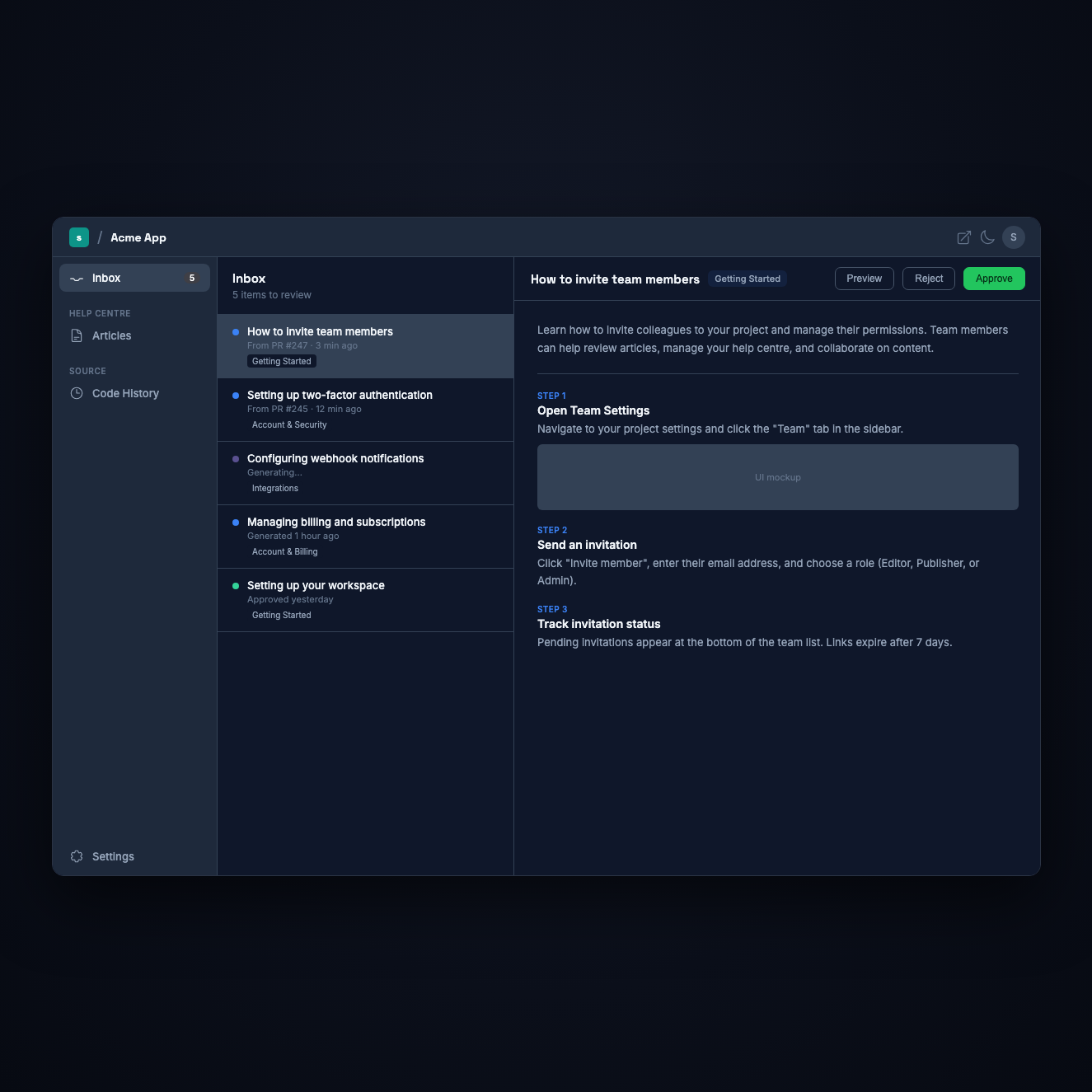
ReadMe is tightly focused on interactive API documentation and developer usage experiences. Mintlify is stronger when API references must sit inside a broader, highly customizable developer-documentation platform.
Mintlify explicitly supports guides, conceptual documentation, changelogs and other developer content alongside API references. ReadMe also supports guides, but its differentiating centre remains the API developer experience.
They can publish product guidance, but teams with large amounts of UI-focused end-user help should evaluate a dedicated help-centre workflow such as SupportPages separately.
See the help articles SupportPages recommends for your actual product—including the screenshots and walkthroughs that make the instructions usable.