
Choose Mintlify
Polished developer and API documentation with AI-native delivery.
Head-to-head comparison
Choose Mintlify for a managed developer-documentation platform with API and AI-native features. Choose Docusaurus when open-source ownership and complete React control justify operating the site yourself.

The short version
Choose Mintlify
Polished developer and API documentation with AI-native delivery.
Choose Docusaurus
Engineering teams that want complete React and hosting control.
Consider a third workflow
Generate customer-facing help from the application codebase, then review it before publishing.
Query-specific analysis
Platform ownership
Choose Mintlify when hosting, search, analytics and platform evolution should be a vendor responsibility. Choose Docusaurus when the organization deliberately wants those systems and the React implementation under its control.
Customization boundary
Managed theming is not equivalent to owning the frontend. Test the components, routing, authentication and integrations that are genuinely product requirements rather than assuming maximum flexibility is always valuable.
API and agent delivery
API references, search, assistant and agent-facing delivery arrive as one product. With Docusaurus, evaluate the cost, data flow and maintenance of every service needed to reproduce that experience.
Total cost
Docusaurus has no licence fee, but upgrades, deployment, search and incidents require time. Assign an owner and an annual maintenance estimate before treating open source as the cheaper option.
Verify current details Mintlify product Mintlify pricing Docusaurus product Docusaurus pricing
We reviewed the vendors' current product documentation and pricing pages, separated sourced facts from our editorial recommendations, and did not treat a longer feature list as a universal winner.
SupportPages publishes this comparison. We state where other products are the better fit and separate sourced product facts from our editorial recommendations.
| Product | Primary audience | Content starts from | Keeping docs current | Visual documentation | Publishing model |
|---|---|---|---|---|---|
| Mintlify | Developer, API and product-documentation teams | Markdown, MDX, API specifications and connected repositories | Agent-created pull requests and automated workflows | Rich MDX components and uploaded media | Managed documentation platform |
| Docusaurus | Engineering and open-source teams | Markdown, MDX and custom React code | Owned by the engineering team and its chosen tooling | Custom React components and uploaded assets | Self-managed static documentation site |
The reasoning
The context behind the quick verdict, including when switching will not solve the underlying problem.
This comparison is managed platform versus owned framework. Mintlify supplies hosting, authoring conventions, search, analytics, API tooling and agent-facing delivery as an integrated product. Docusaurus supplies a flexible React foundation and leaves the rest to the adopting team.
Neither model is inherently better. The question is whether documentation infrastructure is a capability the company wants to own.
Mintlify is the practical choice when the team wants a polished developer-docs experience without assembling and maintaining the surrounding stack. It is especially relevant when API references, semantic search, AI assistants, MCP or agent analytics are requirements rather than future integrations.
The tradeoff is platform dependence and less unconstrained control than a custom React application.
Docusaurus makes sense when engineers want content in portable Markdown or MDX, need custom React behavior and are comfortable selecting deployment, search, analytics and AI integrations. Open-source projects and infrastructure-capable teams can build exactly the experience they want.
The licence may be free, but every integration and upgrade has an owner. Include that work in the comparison.
Mintlify can automate parts of maintenance; Docusaurus can host any process a team builds. Both still depend on a clear content strategy. If the organization has no owner converting product releases into end-user guidance, solve that operational problem rather than expecting the publishing layer to absorb it invisibly.
A different workflow
Both choices assume the team is building and maintaining a documentation corpus. SupportPages is for SaaS teams that want the application codebase to produce customer-facing article recommendations, screenshots and walkthroughs, with a managed help centre after review.
See how SupportPages works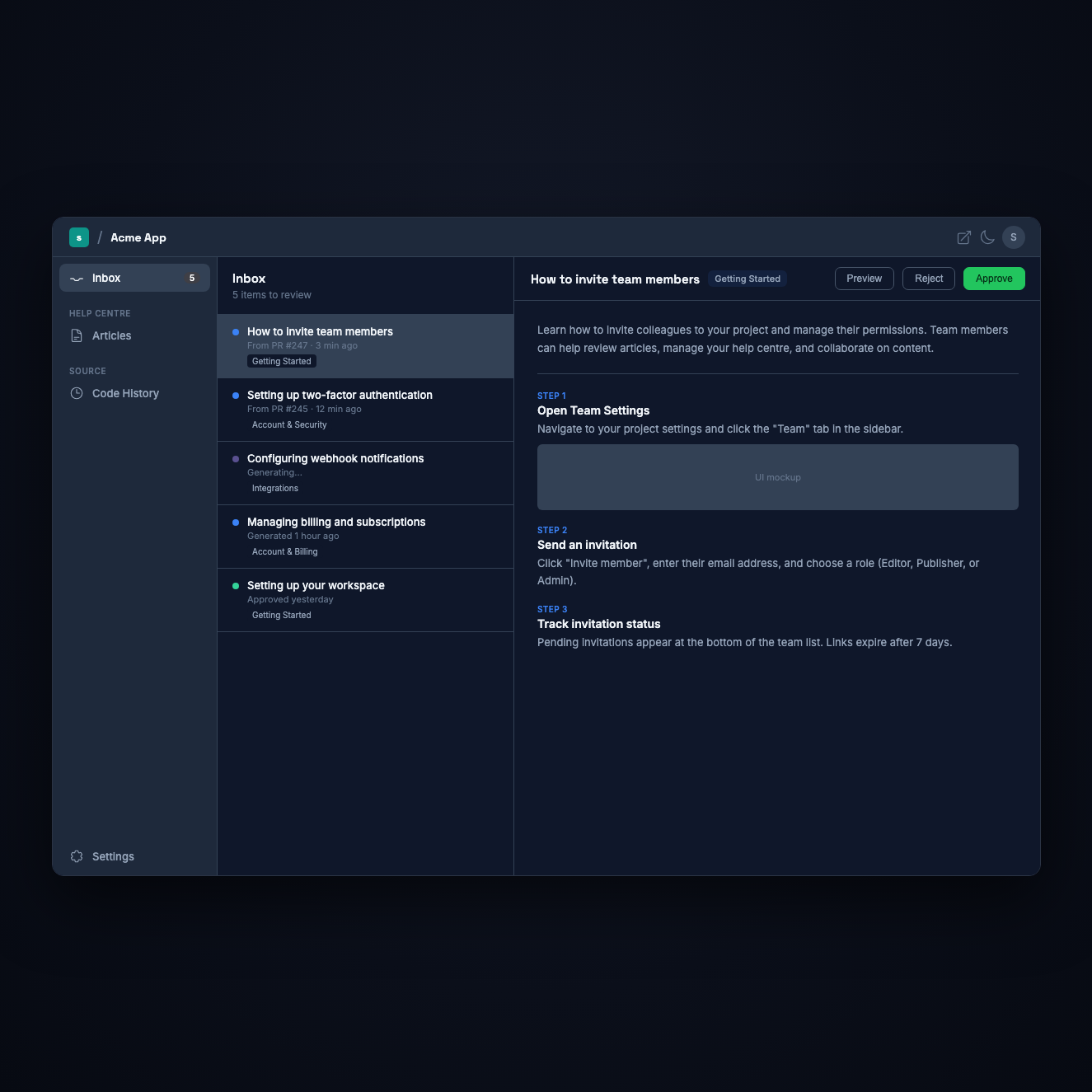
Docusaurus has no software licence fee, but the adopting team owns implementation, hosting, search, integrations, upgrades and maintenance. Compare total engineering cost rather than licence price alone.
Docusaurus offers complete React-level implementation control. Mintlify provides extensive managed customization without requiring the team to operate the full frontend stack.
Mintlify offers agents and workflows for proposed documentation changes. Docusaurus is a framework, so maintenance depends on the process and tooling the team builds around it.
See the help articles SupportPages recommends for your actual product—including the screenshots and walkthroughs that make the instructions usable.