
Choose Intercom Help Center
Teams already using Intercom for support, Messenger and Fin.
Head-to-head comparison
Choose Intercom Help Center when knowledge should power Messenger, Inbox and Fin in an Intercom-led support experience. Choose Zendesk Knowledge for established service organizations centered on Zendesk workflows and governance.

The short version
Choose Intercom Help Center
Teams already using Intercom for support, Messenger and Fin.
Choose Zendesk Knowledge
Support organizations that want knowledge inside Zendesk service operations.
Consider a third workflow
Generate customer-facing help from the application codebase, then review it before publishing.
Query-specific analysis
Existing support architecture
Knowledge is most valuable when agents, conversations, reporting and AI already use the same context. A migration needs a service-level reason; a nicer public theme is rarely sufficient.
Conversational versus service operations
Use real customer journeys to compare how a question moves from self-service to an agent and back into improved knowledge. The distinction is operational, not simply a list of article features.
Separate documentation surface
Define who owns product help, how agents find it, how AI systems ingest it and which release event triggers updates. Separating the corpus can help product teams without pretending to replace the support platform.
Migration and total cost
Export representative articles, preserve redirects and test agent search, escalation and reporting. Compare current suite, seat and AI pricing only after the target workflow is proven.
Verify current details Intercom Help Center product Intercom Help Center pricing Zendesk Knowledge product Zendesk Knowledge pricing
We reviewed the vendors' current product documentation and pricing pages, separated sourced facts from our editorial recommendations, and did not treat a longer feature list as a universal winner.
SupportPages publishes this comparison. We state where other products are the better fit and separate sourced product facts from our editorial recommendations.
| Product | Primary audience | Content starts from | Keeping docs current | Visual documentation | Publishing model |
|---|---|---|---|---|---|
| Intercom Help Center | Customer-support teams using Intercom | Articles, imports, synced sources and support knowledge | Knowledge Hub workflows and content-performance insights | Rich article media | Help centre integrated with Intercom channels |
| Zendesk Knowledge | Established customer-service organizations | Knowledge editor and support interactions | Agent workflows, governance and AI-assisted knowledge | Rich help-centre article media | Knowledge inside the Zendesk service suite |
The reasoning
The context behind the quick verdict, including when switching will not solve the underlying problem.
Intercom and Zendesk both treat knowledge as part of customer service, not an isolated website. That makes the broader support architecture more important than small differences in article formatting.
The right question is where conversations happen, how agents find and share knowledge, which AI system answers from it and how permissions and reporting are governed.
Intercom Help Center content can participate across Messenger, Inbox, outbound messaging and Fin. Teams already using those channels gain a coherent content loop and can manage multiple sources through Knowledge Hub.
Zendesk Knowledge fits organizations whose ticketing, agents, governance and reporting already centre on Zendesk. It is designed to serve a mature support function in which knowledge is one component of a larger service process.
Some product teams release often enough that documentation needs its own trigger and owner. A separate system can connect changes in the application to public help content while the support organization keeps its existing inbox. Treat that as a deliberate two-system design, not an assumption that a help centre alone can replace a support platform.
A different workflow
This comparison covers only the knowledge layer. SupportPages does not replace either company's inbox or ticketing platform; it can replace or complement the public help-centre workflow when the product team wants end-user articles, screenshots and walkthroughs generated from the codebase.
See how SupportPages works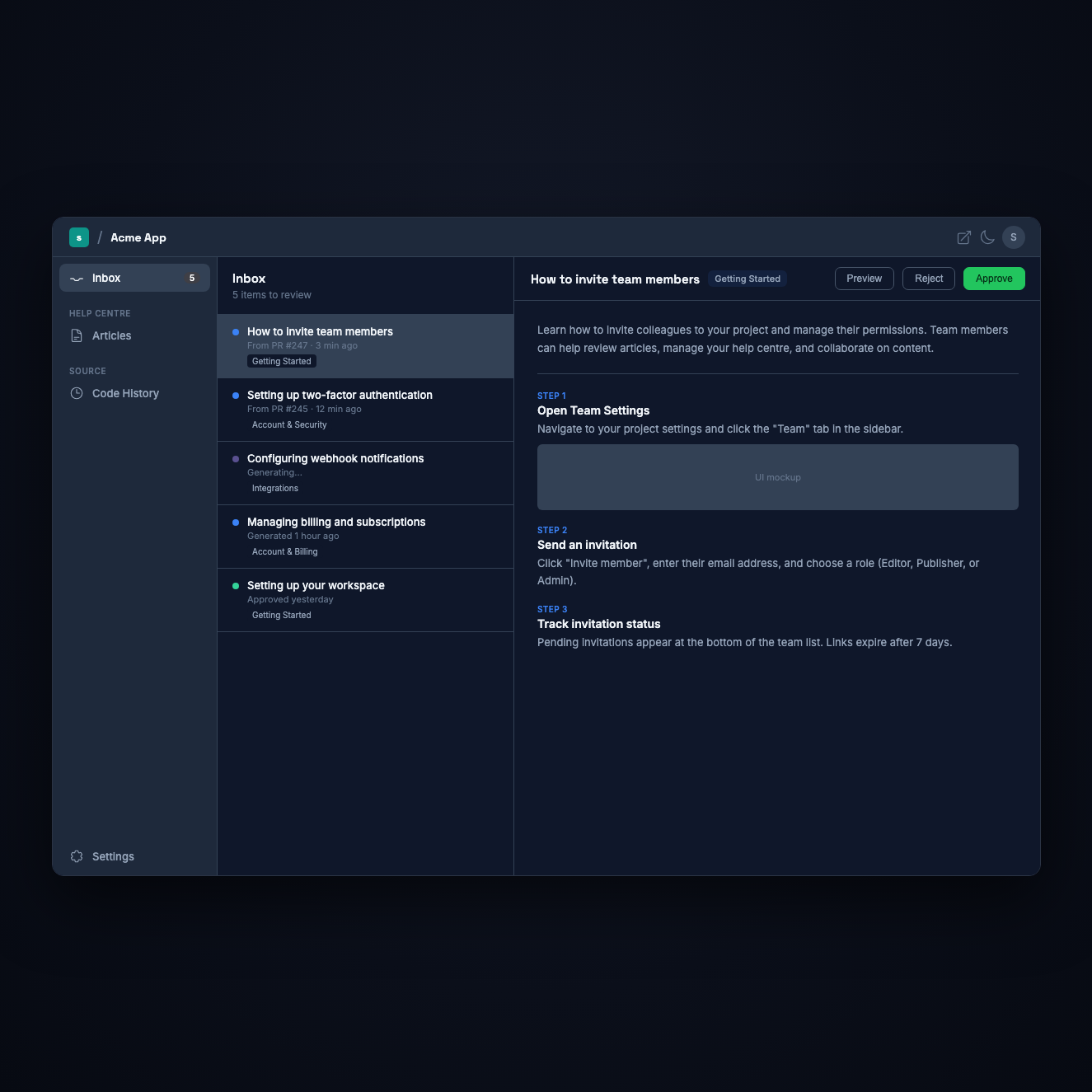
Intercom is strongest when the help centre should feed Messenger, Inbox and Fin. Zendesk is strongest when knowledge belongs inside a mature Zendesk service operation. The surrounding support stack usually decides the answer.
Yes, but verify how agents will search, share and maintain external content and how the chosen AI support tools ingest it. Separating systems is useful only when the documentation workflow gains more than the support workflow loses.
No. SupportPages focuses on customer-facing documentation generated from product code. It does not provide the full inbox, ticketing and omnichannel service capabilities of Intercom or Zendesk.
See the help articles SupportPages recommends for your actual product—including the screenshots and walkthroughs that make the instructions usable.