
Internal Docs, Magic Links, and Who Sees What
SupportPages adds team collaboration, internal help centres behind magic-link access, and visibility controls for search engines and LLMs.
Three related things shipped this week, and together they change who SupportPages is for. Until now, a help centre was public and a project belonged to one person. Both assumptions just got removed.
Teams
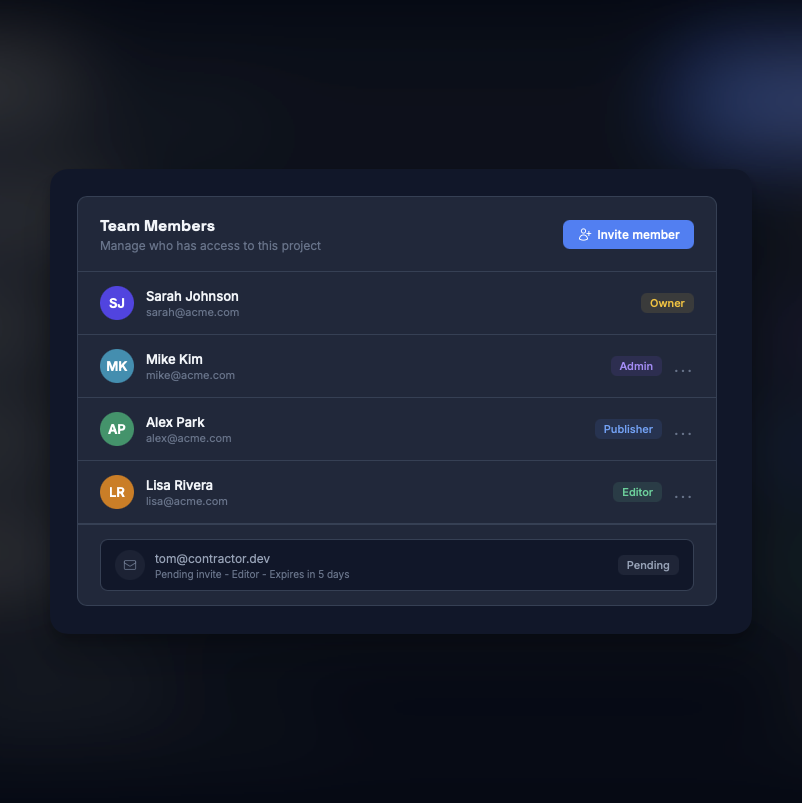
You can now invite teammates to a project. The person who reviews article drafts doesn't have to be the person who connected the repo - which, in most real companies, it shouldn't be. Engineers connect; support and product review and publish. Everyone works from the same inbox instead of forwarding drafts around.
Internal help centres with magic links
Not all documentation wants to be public. Internal tools, admin guides, docs for a beta cohort - teams kept asking for a help centre that only their people could see.
Now a help centre can be restricted by email domain. Visitors hit a gate, enter their work email, and get a magic link - no passwords to provision, no accounts to manage, no SSO project to scope. If your domain's on the list, you're in. Contractors and beta users can be let in the same way.
It's the level of access control that fits documentation: stronger than security-by-obscurity, lighter than an identity project.
Who sees what - precisely
Visibility is now an explicit three-way choice for every help centre:
- Public - on the open web, indexed by search engines
- Public but unlisted - reachable by link, hidden from search
- Restricted - the magic-link gate above
And one detail I care about: the "searchable" setting also governs AI discoverability. If you opt out of search indexing, your docs are also withheld from the llms.txt feeds that make help centres readable to AI agents. Choosing to be invisible should mean invisible to all the robots, not just the ones from 2010.
The pattern
Every company has two documentation debts: the customer-facing one and the internal one. The internal one is usually worse, because at least customer docs embarrass you publicly. Runbooks and how-we-do-things guides just silently don't exist.
The machinery that fixes the first debt - generate from source, review, publish - now has the access controls to start on the second.
Team invites and visibility controls are live for everyone; magic-link help centres are on paid plans. Start free at supportpages.io.
About the Author
Simon Moxon has been building SaaS companies since 2009. He's scaled teams to 20+ people, hit £2m ARR, and learned most of the lessons the hard way. Now he's building SupportPages.io - help docs that write themselves when you ship code. He writes about what's changed in SaaS and what hasn't.